


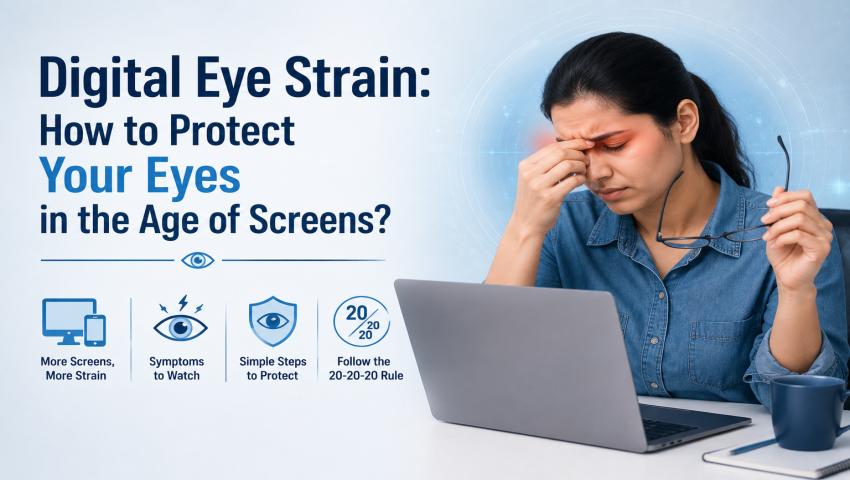
From the moment our alarms go off in the morning to the final scroll through social media before bed, our eyes are locked in a continuous battle with digital screens. Whether you are a software professional working in Hinjewadi, a student attending online classes, or someone who loves catching up on digital entertainment, screens have become an inseparable part of modern life.
However, our eyes were never evolutionarily designed to stare at bright, artificial, high-contrast light sources for hours on end. The result? A rapidly growing global health epidemic known as Digital Eye Strain (DES), or Computer Vision Syndrome (CVS).
If you frequently experience headaches, blurry vision, or a burning sensation in your eyes by mid-afternoon, your screens are taking a heavy toll. Fortunately, protecting your vision does not mean giving up your digital devices completely.
The Mechanics of Digital Eye Strain:
To protect your eyes, it helps to understand why screens cause so much fatigue compared to reading a physical book.
First, digital devices emit high-energy visible (HEV) blue light, which scatters easily and reduces visual contrast, forcing the eye muscles to work harder to maintain focus. Second, characters on a screen do not have the sharp, well-defined edges of printed ink; they are made up of tiny pixels that continuously refresh, requiring the eye to constantly refocus.
Most importantly, we forget to blink. On average, a human being blinks about 15 to 20 times per minute. This action spreads a fresh, protective layer of tears over the cornea, keeping the eye moist and clean. However, when staring intently at a computer or smartphone screen, our blink rate drops by more than 50%. This prolonged exposure causes the tear film to evaporate rapidly, leading to severe dryness, inflammation, and irritation.
Red Flags: Symptoms You Shoudn't Ignore
Digital Eye Strain isn’t just about feeling “tired.” It manifests through a spectrum of physical discomforts:
- Dry, red, irritated, or burning eyes
- Frequent, dull headaches originating behind the eyes or in the forehead
- Blurred or double vision, especially when looking up from a screen
- Difficulty shifting focus between distant and near objects
- Neck, shoulder, and back pain caused by poor posture while viewing devices
Practical Strategies to Shield Your Sight:
You can drastically reduce the impact of Computer Vision Syndrome by implementing a few simple, scientifically proven adjustments to your daily routine:
- Master the 20-20-20 Rule: This is the golden rule of digital wellness. Every 20 minutes, take a break from your screen and look at an object at least 20 feet away for a minimum of 20 seconds. This simple exercise allows the ciliary muscles inside your eyes to relax completely, preventing chronic accommodation spasms.
- Optimize Your Workstation Ergonomics: Position your computer screen so that the top of the monitor is at or slightly below eye level. You should be looking slightly downward at your work, which exposes less of your eyeball’s surface area to the air, minimizing tear evaporation. Keep the screen roughly an arm’s length (20 to 28 inches) away from your face.
- Control Ambient Lighting and Glare: Harsh overhead fluorescent lighting or direct sunlight streaming through windows forces your eyes to strain against the screen’s reflection. Use anti-glare screen filters, position your monitor away from direct window light, and adjust your screen’s brightness so it matches the ambient light level of the room you are in.
- Consciously Practice Blinking: Post a sticky note on your monitor that says “Blink!” It sounds simple, but retraining your brain to blink fully and frequently while reading digital text is one of the most effective remedies against dry eye syndrome.
Advanced Ophthalmology Care at Dr. Maid Hospital:
While lifestyle modifications can offer immense relief, persistent eye strain can sometimes mask underlying vision problems, such as uncorrected refractive errors, astigmatism, or early-stage dry eye disease.
At Dr. Maid Hospital’s Advanced Ophthalmology Care Department, we provide comprehensive visual assessments using state-of-the-art diagnostic equipment. Our specialized eye care team evaluates your tear film quality, checks for hidden vision adjustments, and provides customized solutions—ranging from high-quality anti-reflective blue-cut lenses to advanced therapeutic eye drops for chronic dry eyes.
Your eyes are your window to the world. Do not let excessive screen time dull your vision. Schedule a comprehensive eye examination at our facility today, and let us help you build a healthier, clearer relationship with the digital world.